Friday, May 15, 2020

DREAMS of a Crown Part 2: Major Ruins

Part 2 of my continuing hackage of Renegade Crowns. This time: Major Ruins.

Major Ruins are significant dungeons or other ruins that have the potential to have a wide impact on the world around them. They might not be the biggest or baddest dungeon in the region, but something inside them can do a lot more than eat adventurers.

Major Ruins have an Origin, which is who and when it was built. Inside them is a Menace, whatever evil power could threaten the world if it got out. There's a Status, which speaks to what the Menace is doing right now. There's the Purpose, which is the original, well, purpose of this Ruin. And there's the Reason for Ruination. I feel like that one's self-explanatory.

PART TWO: MAJOR RUINS

There are d10 ruins per GIGAHEX. For each one, roll on the tables below to figure out what it is and what's going on. If you've got favourite megadungeons, you could use those instead.

MAJOR RUIN ORIGIN (d6)

  1. Pre-Apocalyptic Human. Like buried malls, and fallout shelters, and missile silos, and megachurches.
  2. Ancient. d4: 1-2 Neolithic Human. 3 - Cyclopean. 4 - Fairy.
  3. Outsider. d4: 1 - Weird Magitech. 2 - Gonzo Underworld. 3 - Demonic. 4 - Alien.
  4. Druidic humans.
  5. Imperial humans.
  6. Recent human.

MENACE (d6)

  1. Plague. d6: 1 - Natural. 2 - Techno-Engineered. 3 - Alien. 4 - Eldritch. 5 - Mutagen. 6 - Intelligence.
  2. Lair. d6: 1 - Dragon. 2 - Monstrosity. 3 - Intelligence. 4 - Undead. 5 - Demon. 6 - Fairy.
  3. Weapon. d4: 1 - Construct. 2 - Destroyer. 3 - Wielded. 4 - Materiel.
  4. Sleeper. d6: 1 - Elder Thing. 2 - Undead. 3 - Intelligence. 4 - Outsider. 5 - Cryo. 6 - Alien.
  5. Army. d6: 1 - Swarm. 2 - Horde. 3 - Praetorians. 4 - Cursed. 5 - Outsider. 6 - Revival.
  6. Portal. d6: 1 - Hell. 2 - Space. 3 - Dimension X. 4 - Far Past. 5 - Fast Travel. 6 - Roll twice.

STATUS (d8)

                        Plague    Lair    Weapon    Sleeper    Army    Portal
Contained         1-6         1           1-3           1-4          1-5        1-4
Passive              -            2-4        4-6           5-6          6-7        5-6
Threatening      7-8         5-6         7               -              8         7-8
Scheming.         -            7-8         8             7-8            -            -

PURPOSE (d10)

                     Pre-Apoc    Ancient    Outsider    Druidic    Imperial    Recent
Fortress           1-3              1-3            1-2           1-3             1               1-2
Outpost           4-5                -              3-5             4             2-3             3-5
Settlement       6-7               4               -                -               4                 6
Temple            8-9              5-7            5-8           5-7           5-7              7-9 
Tomb                10             8-10          9-10         8-10         8-10              10

REASON FOR RUINATION (d8)

  1. Internal Conflict
  2. Disappearances/Abductions
  3. Famine
  4. Magic
  5. Attack
  6. Natural Disaster
  7. Plague
  8. Abandoned

Ruin Origins

Pre-Apocalyptic Human
The buried remains of human civilization before the bombs fell, the comet hit, the Elder Things awoke, or whatever poorly defined and incomprehensible calamity befell. Loot from modern location maps, video games, or whatever. The contents of these places should be recognizable to the players, but not the PCs.

Ancient
Pre-historic remnants.  
  • Neolithic are human. The ruins are likely to be little more than empty rock walls and simple construction. 
  • Cyclopean are built by giants, huge block construction and oversized buildings. 
  • Fairy is, well, stuff built by faeries when they were still common and slightly less asshole-ish.

Outsider
This is stuff constructed by minds beyond the understand of PCs and maybe players as well. 
  • Weird Magitech is left behind by forgotten, advanced civilizations. Deep Carbon Observatory, for example.
  • Gonzo Underworld. The weird and wacky that lives under the world. Giant talking centipedes and ray-gun wielding cockroaches and frothing cultists sacrificing to albino fish-gods.
  • Demonic. Temples dedicated to the powers of great evil, hellish incursions into our realm, junk like that.
  • Alien. This might be fantasy alien, like tentacle-faced brain eaters that travel space in nautiloid ships, or, like alien aliens with saucers and probing. Or, uh. those other aliens with the bursting of chests.

Druidic
The original inhabitants of this land. A druidic, clannish Bronze Age people with heroes and gods and sweet tattoos. They built stone circles and hill forts and raided cattle.

Imperial
Some bunch of jerks followed a bigger jerk and conquered the known world into one big empire. The head jerk died, but the empire stuck around for several centuries and did a decent job of making everyone talk and worship like them. Until they couldn't any more, and collapsed into chaos.

Recent Human
The last hundred years or so. Imperials who stuck around after the empire collapsed and have been creating a new identity. Outsiders who came to settle and took up the empire's god for their own. The remaining druidic people, though they've mostly taken up the imperial god, too. Newer invaders, the ones who come from a land of ice and snow and hotsprings and are quite happy with their own gods, thanks.

Menaces

These are the big scary things lurking in the ruins, waiting for dumbass adventurers to come and let them loose.

Plague
A virus or other pandemic-level infectious threat.
  • Natural. Just a regular ol' plague. It might have magical interactions, but it's natural in nature. There may be a known cure for it, or at least a way of containing it.
  • Techno-Engineered. Either a relic of pre-apocalyptic technology, or magitech. This might be a bio-weapon, a retrovirus that converts the infected into rage zombies, or something else. Point is, it was created by someone to do something specific and that creator likely had some form of controlling it.
  • Alien. This plague is extra-terrestrial in origin. It might render the infected down to their composite goo, convert them into the alien lifeform, or mind-control them into constructing a portal. The protomolecule from The Expanse, or the weird sperm stuff from Prometheus.
  • Eldritch. A plague of madness and cosmic horror. Annihilation or Color Out of Space. Yes I know both of those are technically alien but they've got the Eldritch vibe.
  • Mutagen. Mutates the infected into something else. This might be intended as a beneficial change, like turning them into 10-foot-tall super-muscled green dudes - or it might just be a zombie virus. The FEV virus from Fallout, or the T-virus from Resident Evil.
  • Intelligence. This virus is alive, and it thinks. It might be an artificial intelligence, like a computer virus that's gained sentience and learned to infect more than just silicon, or a living spell, or an alien lifeform. Unlike the others, it has wants and can reason.
Lair
This ruin is something's home, and that something may have plans of its own.
  • Dragon. It's a dragon. You know the drill.
  • Monstrosity. This is some horrible, gribbly monster. It might not be as intelligent or scheming as a dragon, but it can and will wreak terrible destruction if provoked and/or freed.
  • Intelligence. Some form of disembodied intelligence. An artificial intelligence that has survived the long millennia since it was first programmed, an alien life-form, a living spell, etc.
  • Undead. Lich, vampire, mummy lord, wight king, etc.
  • Demon. A thing from hell, manifest in our world. It might have been trapped or imprisoned here, summoned as guardian, caught by wards, or trying to kick-start a wider demonic incursion.
  • Fairy. A power sidhe resident in the mortal realms. Maybe a prisoner, maybe an exile, or a recluse. Maybe an infiltrator. Or maybe all of the above. Hard to tell with fairies.
Weapon
Something that can cause havoc, but not on its own.
  • Construct. A war machine with some level of autonomous function. A war-golem. A battlemech. A magic hybrid-beast. An unthinking entity that may or may not respond to new masters.
  • Destroyer. This weapon can cause destruction on an unheard of level. An unexploded atom bomb. A world-cracking spell. A captured black hole.
  • Wielded. This weapon must be picked up and used. Excalibur, the One Ring, a really really big gun. May or may not be intelligent.
  • Materiel. This is not a single weapon, but all the gear needed to equip an army. A pre-apocalyptic army depot, the collected arms and armour of a thousand conquered armies, twelves cases of rayguns.
Sleeper
A powerful entity of uncertain motives that is currently asleep, in stasis, or otherwise not-dead-but-dreaming.
  • Elder Thing. Great Cthulhu. The Kraken. An immensely powerful, ancient, and probably deeply hostile life-form that has spent eons in slumber.
  • Undead. Much like the Undead listed in Lair, but asleep. The mummy lord is still in his sarcophagus. The lich has been astral projected for twelve centuries. Somebody dusted the vampire queen, and her ashes are just waiting for that single drop of blood.
  • Intelligence. Push that big red button and Skynet turns back on. Tap the crystal and the unknowable frequency entity will wake.
  • Outsider. An entity from another plane is held here. An angel, a demon, an incomprehensible thing of pure chaos. Good luck telling the difference before you wake it up.
  • Cryo. Someone's been frozen. Survivors of global war, waiting out the nuclear winter. Psychic dinosaurs caught in sudden ice age. A shape-shifting alien crashed into a glacier.
  • Alien. Ten wrong-looking mummies on ten crystal thrones. A leathery egg in a bricked-up chamber. An impossible saucer buried under mud and time.
Army
A large group of individuals that can fuck shit up and probably will if they have their way.
  • Swarm. A vast number of unthinking, violent creatures. Zombies, demonic wolves, killer drones, terracotta soldiers, giant ants.
  • Horde. A large number of thinking, violent creatures. Omnicidal robots, army of wights and ghouls, a regiment of British redcoats thrown through time, the degenerate and mutated descendants of the ruin's builders.
  • Praetorians. A small group of elite, disciplined fighters. Typically the dedicated guard of a place or person. An order of knights or warrior-monks, the retinue of an emperor, that kind of thing.
  • Cursed. An army under a curse. Maybe they stole treasure and become skeletons if they leave the ruin. Ghosts trapped in eternal battle. Soldiers infected with a techno-virus that constantly rebuilds their bodies even as their minds fracture.
  • Outsider. A choir of angels, a manifold of weird robots from a plane of pure law, a clutch of minor demons.
  • Revival. These are the descendants of a now-fallen culture and they're planning to bring it back with great fire and furious force. They're probably assholes, too. Or maybe they think they're benevolent, but they'll still need to bulldoze your house to build their paradise.
Portal
A gateway between worlds, or times. Might not be dangerous on its own, but who knows what could come through if you open it, or where you might end up.
  • Hell. A gate straight to the hot place.
  • Space. Might go to the moon, or another planet if you're lucky. Deep dark space if you're unlucky. The place between the stars where the twelve crystallized gods of chaos sleep if you're really unlucky.
  • Dimension X. A portal to another layer of reality. Might be a fantasy plane, an alternate reality or timeline, or someplace where the laws of reality are different entirely.
  • Far Past. A gateway to before the apocalypse, the time of dinosaurs, when the druids roam, primeval earth, or something else.
  • Fast Travel. Connects to somewhere else in this time and this reality.
  • Roll twice. Maybe it connects to two different places, or the destination has features of two things, or whatever else you can think of.

Status

The current, er, status of the menace. What it's up to, and what adventurers will find when they poke their noses in.

Contained
Whatever the menace is, it's trapped within the ruin. Either by accident, or because the ruin was designed or altered to become a containment facility, a prison, or a trap. The menace may not be aware of the world outside the ruins, or it may chafe at its bars.

Passive
The menace is not confined to the ruin, but remains there of its own volition. It may simply be inwardly-focused, uninterested in the wider world, or it maybe be unaware that there is a wider world to be interested in.

Threatening
The menace poses a threat to the world outside the ruin. An army might be raiding nearby settlements, or a plague might be infecting passers-by.

Scheming
The menace has plans, and those plans do not bode well for people leaving in the region. Its plots and actions may not be noticeable yet, but that does not make it less dangerous. Alien dopplegangers infiltrate society, the dreams of an elder-thing draw cultists who prepare sacrifices, scouts of an awakened army plot sabotage.

Purpose

This is the original reason the ruins were built, or possibly what they were converted into before they became ruins.

Fortress
This ruin was a fortification, intended to protect and defend and generally be military. Generally these types of ruins are hidden, isolated, or otherwise unusable as defensible locations and strong walls just keep getting used and built on top of. Imperial fortresses in particular are prime candidates for continuing use.

Outpost
This ruin was a small, self-contained location in a (then) outlying area. Border forts, remote steadings, isolated vaults. Because of their smaller size, these ruins tend to be either more recent, very well-hidden, or very well-constructed.

Settlement
This was once a place where people lived. Like fortresses, places conducive to settlement tend to see continual occupation unless they are truly remote or become dangerous or otherwise undesirable.

Temple
A place of worship and/or contemplation. This might be a literal temple, or it might have an adjacent function, like a library or an observatory or an arena. These ruins can persist even quite near to inhabited places if they are regarded with sufficient fear or reverance.

Tomb
A place where the dead are laid to rest, or a figurative tomb where things were hidden away from sight and memory - such as a vault, depot, or laboratory.

Reason for Ruination

Why the ruin became a ruin in the first place. The Menace can sometimes suggest this, or the Menace may be unrelated to the ruination entirely.

Internal Conflict
Civil war, rebellion, oppression, factions and internecine fighting. The inhabitants of this ruin killed each other and any survivors fled. There may be significant damage from the fighting, if it was violent enough, and a great deal left behind (assuming looters haven't gotten to it since then). 

Disappearances and Abductions
The inhabitants just... disappeared. This might have been all at once, or by ones and twos until the survivors fled. The ruins may have suffered little to no damage by the ruination itself, and it's possible that almost everything was left behind.

Famine
The food and/or water and/or air ran out. This may have been rapid, and may have devolved into violence and cannibalism. Or it may have been slow and predicted enough that the inhabitants were able to pack up and leave - and take most of their stuff with them.

Magic
A wizard did it. A magic calamity beset this place. Maybe it killed everyone, or caused rock to melt like butter, or turned everyone into green-goo-oozing blob people. Shit got weird.

Attack
An external hostile force attacked the ruin, and ruined it. Whether the defends won or lost, there will have been extensive damage, and likely looting and/or scavenging. Or maybe both sides were wiped out to the last fighter.

Natural Disaster
Flood, fire, earthquake, hurricane. The elements conspired to ruin this place, to burn away the inhabitants or sink it beneath the waves or drop it into the veins of the earth.

Plague
Everybody got sick. Maybe they all died, or maybe some were able to flee. 

Abandoned
Everybody packed up and left. This may have been to avoid a coming disaster, because a retreat was ordered, or because the location was simply no longer habitable.

Example

I rolled up Major Ruins for the same region I was working on last time.  I got:

A Druidic outpost ruined by natural disaster. Inside is a contained portal to space.
A Druidic tomb ruined by disappearances. A plague is contained within.
An Alien tomb, ruined by magic. A techno-engineered plague is contained within.
A pre-apocalyptic outpost, ruined by military attack. Lair of a scheming undead.
An Ancient temple, abandoned. A mutagenic virus is contained within.
A Recent outpost, ruined by plague. Now the lair of a passive Fairy.
A Recent outpost, ruined by famine. A revivalist army is contained within.
A Recent Tomb, ruined by famine. A revivalist army is contained within.

That's a lot of plagues.  So connecting all these ruins can suggest some details of the major historical events of the region.

The Pre-Apocalyptic Ruin is an old seed vault that was supposed to help survivors of the apocalypse, but it cracked and everything inside was scoured out. A lich moved in a few centuries ago. It has schemes but I don't really need to worry what they are just yet.

The Druidic outpost with the portal was originally a major stellar observatory, complete with complex stone circles and barrows. The portal brought through aliens, before an earthquake buried the whole complex.

The Alien Tomb is the last refuge of the aliens who came through the portal. They attempted to use bioweapons on the locals, but the Druids banded together and destroyed them. The techno-plague the aliens were using is still in the tomb.

The Druidic tomb is where the Druids buried those who died fighting the aliens. Originally a sacred site, it was abandoned when the techno-virus started messing with the buried dead.

The Ancient temple also contains a plague, but a metagenic one. I'll say it's a very old Fairy construction, and they left it behind when they returned to Fairy. Inside is a plague that warps the bodies of mortals, Annihilation-style.

The three Recent ruins are all from the post-Imperial period when things started to turn anarchic. A mundane plague wiped out one outpost, which is now avoided because of the Fae Lord that's taken up residence there. The other two were reoccupied by the last knights loyal to the last Imperial general who tried to unite this land. Their descendants have elevated the general to a religious figure, convinced she'll resurrect and lead them on a glorious crusade of reconquest. The two branches hate each other, though.

Tuesday, May 12, 2020

DREAMs of a Crown, Pt1: Landscaping

tl;dr I hacked up Renegade Crowns from WFRP with my own setting nonsense to create a similar kind of "petty kingdom chaos" generator that leans more to OSR style of scenario design and sandbox play, with (I hope) more concise tables. This is Part 1, generating the landscape.

Whole series here

Okay honestly the tl;dr pretty much captures it. I like making settings and maps and regions as an activity unto itself, and I've been noodling on various methods and systems for generating them for a while. Renegade Crowns provides a good structure for me to bolt my own nonsense and preferences onto. I also wanted to rebuild the tables to be more concise and compact. There's more dice than d100s, y'know. I also replaced Renegade Crown's weirdly patchwork set of biomes with a more consistent array that's based on northern Canada where I grew up because I do what I want.

If you're not familiar with Renegade Crowns, the idea is: there's a big patch of land between larger polities that no-one owns, no-one controls, and no-one really wants too much. So every man-who-would-be-king, exiled noble, jumped up bandit, ambitious adventurer, and pernicious priest comes down to carve out a little princedom of their own. It's a land of chaos, conflict, and opportunity, and there's a whole bunch of tables and advice for creating your own patch of perilous petty princelings.

My own tastes in setting are baked into these tables, but it wouldn't be hard to replace them with your own. I draw (incredibly inaccurately and with gleeful anachronism) from post-Roman Britain with a dash of the Late Bronze Age Collapse in the eastern Mediterranean. Point is, empires have fallen and there's lots of little people scrambling for land and power and safety. And then on top of that is the fantasy weirdness like fairies and demons and UFOs and occasional nuclear waste dumps and buried shopping malls. Normal stuff.

The idea at the end of all this to have a system that can generate big chunks of this chaotic land on the fly, complete with basic history, adventuring sites, settlements, and the jerks trying to make themselves king jerk, and then take all that big picture and run it as a hex crawl and domain game. There should be loads for players to do, even if they don't decide to make themselves Princes, too. The first part, down below, is about generating the landscape and some special features that make up the region.

Here's some assumptions I make. You can skip this section entirely if you don't care.

The World is in Flux. It is a time between empires. This part of the world is sliding into a dark age. There are places, beyond the reach of the common folk, that are ticking along just fine or having their own golden age (see: most of the world during the Dark Ages in western Europe). Nobody knows if a new power will be forged out of the chaos, or who it will be. Power is rarely transferred smoothly between generations. Whole populations are on the move, driven from their own lands and seeking to take someone else's.

Religion is a Big Deal. Religion is how people make sense of the world, seek surety in a chaotic time, and defines their identities versus the other. And religions are in conflict. New, organized religion seeks to wipe away the old faiths. Migrating peoples bring their gods with them, and are both horrified and fascinated by the practices they encounter. And, because this is fantasy, there's demons and gribbly Elder Things and shit looking for their chance to reach into our reality.

Change is Possible, but Hard. Unlike that game that bills itself as perilous and grim I'm not gonna say all your works will crumble and lasting creation is impossible, but it is hard. A bunch of jerks with swords and spells and the will to use them might weld together a patch of land and call it a kingdom, but creating a true nation is the work of an entire people acting together. And not everyone thinks that putting another jerk with a sword on a throne is the best long-term plan...

Magic is Heckin' Scary. Magic and mages are dangerous, to themselves as much as anyone else, and most people never see actual magic. There's no oddly modern academia out there organizing mages with a sorting hat saying whether they're good at illusions or blowing shit up, there's just some bent mf'ers who warp reality and are more likely to kill each other for formulas than invent tenure.

Layers of Civilization. The history breaks down like this:

  • Pre-Apocalyptic. The (mostly) buried remains of a world that looks a lot like ours, ended in fire and calamity. Think Adventure Time but more buried & hidden.
  • Ancient. Neolithic times. Humans in stone huts and living side-by-side with giants and fairies.
  • Druidic. The original inhabitants of this land. A druidic, clannish Bronze Age people with heroes and gods and sweet tattoos. They built stone circles and hill forts and raided cattle.
  • Imperial. Some bunch of jerks followed a bigger jerk and conquered the known world into one big empire. The head jerk died, but the empire stuck around for several centuries and did a decent job of making everyone talk and worship like them. Until they couldn't any more, and collapsed into chaos.
  • Recent Human means the last hundred years or so. Imperials who stuck around after the empire collapsed and have been creating a new identity. Outsiders who came to settle and took up the empire's god for their own. The remaining druidic people, though they've mostly taken up the imperial god, too. Newer invaders, the ones who come from a land of ice and snow and hotsprings and are quite happy with their own gods, thanks.

PART ONE: LANDSCAPING

Okay so first we'll need some hexes to fill. A single HEX is 4 miles across - thus in a day you can cross two hexes in open terrain, three on a road, or one in difficult terrain (assuming your elfgame of choice doesn't say otherwise). A hex of hexes, five across and nineteen total is a MEGAHEX.  Nineteen of those in a matching five-across arrangement is a GIGAHEX. That's a total of 361 hexes, for a total area of just over 5000 square miles (or just shy of thirteen thousand square kilometers, for those of us free of imperial measurements in normal daily life and yet shackled to them by the conventions of elfgames).


The first step is to fill in the biomes and any special natural features.  Roll on the BIOME table to fill in the hexes, then roll on the sub-table for how many hexes to fill..  If you want to randomize where a biome starts or a special feature is located, roll a d20 to pick a MEGAHEX. If you want the specific hex, repeat the d20 roll within the MEGAHEX.

Roll a d12 & d4 on BIOMES. The d12 is which biome, the d4 is for the sub-table of how many hexes that biome will fill.

BIOMES (d12 & d4)
1 - HILLS (1-2 3d20, 3 d100, 4 d20x10) (1-3 Rocky, 4-6 Forested)
2 - MOUNTAINS (1-2 3d20, 3 d100, 4 d20x10) (1-3 Low, 4-6 High)
3 - FOREST  (1-2 3d20, 3 d100, 4 d20x10)
4 - PLAIN  (1-2 3d20, 3 d100, 4 d20x10)
5 - WETLAND (1-2 d20, 3 2d12, 4 3d12)
6 - RIVER
7 - LAKE (1-2 d4, 3 d6, 4 d10)
8 - CLIFF (1 d4, 2 d6, 3 d8, 4 d10)
9 - FERTILE VALLEY (1-2 d12, 3 d20, 4 3d10)
10 - HAZARD ZONE (1-2 d12, 3 d20, 4 3d10)
11+ - SPECIAL

SPECIALS (d12)
1 - CAVES
2 - BUTTE
3 - VOLCANO
4 - WATERFALL
5 - RAPIDS
6 - HOTSPRINGS
7 - CRATER
8 - EPIC PEAK
9 - ROAD (d20 long) (1-2 Imperial, 3-4 Druidic, 5 Ancient, 6 Pre-Apoc)
10 - BRIDGE (1-2 Imperial, 3 Druidic, 4-5 Ancient, 6 Pre-Apoc)
11 - CANYON (d12 long, with side branches d4 long for every 5 full hexes)
12 - NECROPOLIS (d4 layers: Recent, Imperial, Druidic, Ancient)

HILLS


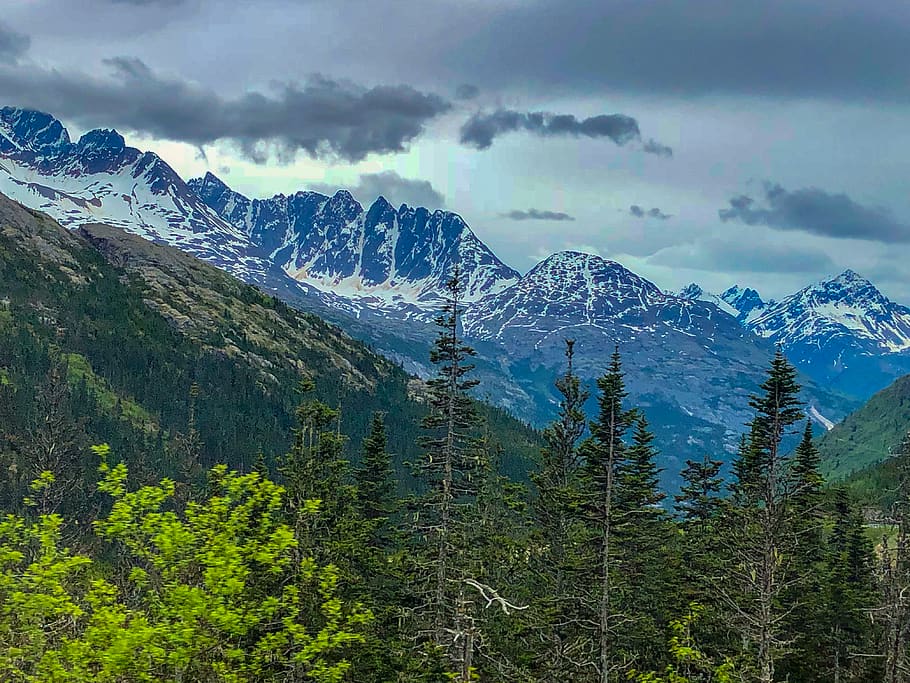
  • Steep-sided hills that tend to form long, parallel ridge-lines.  
  • Forested hills are low and gently sloped  enough to have tree coverage on the top, typically boreal spruce forest.  Hills that have been tended or terraced may be able to support orchards (apples, pears, and berries in particular) or vegetable and gourd farming.
  • Rocky hills are higher and steeper and have a defined tree-line part way up or at the base and often have boulder-strewn approaches, rockslides, and steep escarpments. The soil on top is rarely thick enough to support much more than hardy grasses, but they can provide grazing land for goats, sheep, and ponies.

MOUNTAINS


  • Steep, jagged mountains. Glacier-scraped and volcanic rock.
  • Low mountains have a squat appearance, with a broad profile and a low, wide peak. The tree line is defined, though it may reach most of the way up. These mountains have thin soil, supporting only stunted spruce trees. The thin grass on the summits is unlike to support anything but the hardiest of goats.
  • High mountains are steep and have sharp ridge-lines. The tree line reaches only to the foot of these mountains, and the peaks are snow-capped year round.

FOREST


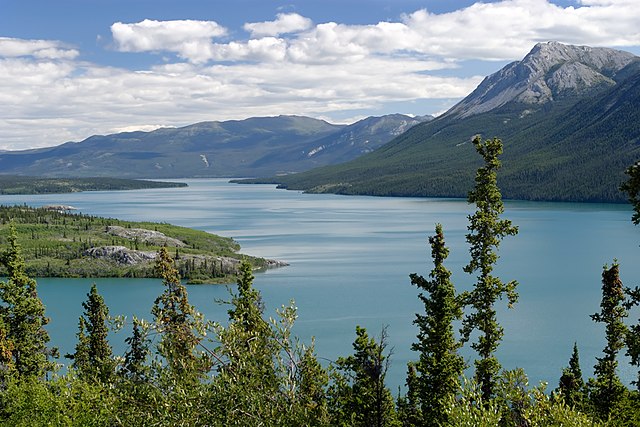
  • There are two primary types of forest in the region. Neither support the giants of more southern lands, and a tree that survives fifty winters might not top twenty feet.
  • In valleys, lowlands, and other areas with water and fertile soil grow primarily aspen and poplar forests. These trees grow quickly (relatively, for the region) and are commonly used for building material. These types of forest, if cleared and irrigated, can support farming - mostly cold-tolerant crops like bere and rye, with oats and some wheat near the coast, though the short growing season and thin soil limit harvest size.
  • In higher elevations and where the coastal rains are blocked by mountains the forests are dominated by spruce trees.  These forests are unsuited for grain farming, as the soil is thin, rain is scarce, and permafrost is not far below the surface. Vegetables, roots, and gourds can be grown, as can berries and flowers.

PLAIN


  • Plains in low-lying areas exist only as a result of deforestation by human hands. The Druidic and Imperial people both engaged in land clearing for agriculture, though many of those areas are slowly returning to forest without active maintenance and farming. If they can be worked (and defended) these plains can become productive farmland.
  • Plains at higher elevations are tablelands, high plateaux swept by bitter winds and receiving little water beside snow. They may be dotted with small, twisted spruce or small groves of aspen around springs and streams, but are mostly tough grass, lichens, and rocks. In spring and summer these areas explode with colour as the wildflowers bloom.

WETLAND


  • Near the coast and along rivers wetlands are marshes - dominated by grasses, reeds, bushes, shallow ponds, and few trees. Crossing marshland is difficult, as the shallow pools and soft ground cannot be crossed with boats, while also being dangerous to walk through.
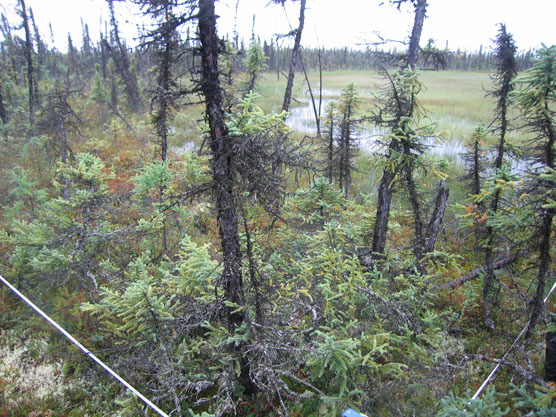
  • Inland and at higher elevations, wetlands are muskeg bogs. These peat bogs form when groundwater can't drain due to permafrost and the weather is too cold for major evaporation. The wet ground and plant life decay and form thick peat deposits. Grasses and stunted spruce trees dot the surface of a muskeg bog, along with moss and shallow water. Muskegs can be extremely difficult to cross and deceptively dangerous. What looks like a moist, grassy field may actually be peat and moss mats floating atop standing water and thick mud, ready to suck the unwary down into the mire.

RIVER


  • When placing a river, remember that rivers flow from high ground to low, join but do not split (except in deltas) and all flow in roughly the same direction - to the sea.
  • If you need a random hex within a MEGAHEX for a river to start or exit, roll d20.
  • At high elevations, rivers are fast, narrow, and straight. Rapids are common.
  • At low elevations, and around wetlands, rivers may be wider, slower, and wind more. Oxbow lakes sometimes form in broad valleys where the river has meandered.

LAKE


  • Freshwater lakes, cold and still. Refreshed by snowmelt and freeze solid in the winter. Home to trout, pike. May fill a narrow valley between mountains, be created by a beaver dam, or be the confluence of several rivers. With limited evaporation, and bedrock and permafrost keeping water on the surface, lakes can grown immense - especially at the foot of mountains that shed snowmelt every spring.
  • Moose frequent the shallows and marshy ground around lakes, and the wolves follow them. 
  • Control of a lake means control of traffic along it. Princes have fought sea battles with canoes and skiffs.

CLIFF


  • Cliffs, typically formed by erosion and subsidence, form long boundaries between biomes. They might bound a flat river valley between mountains, form the edge of a high plateau, or separate coastal plains from inland hills.
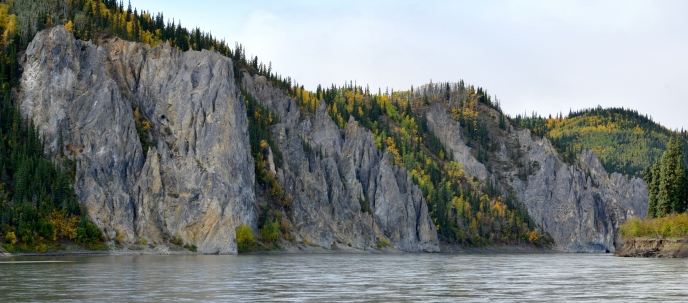
  • Cliffs bordering mountainous areas are typically sheer rock walls. The average height of such cliffs is 100+(d6x50) feet.
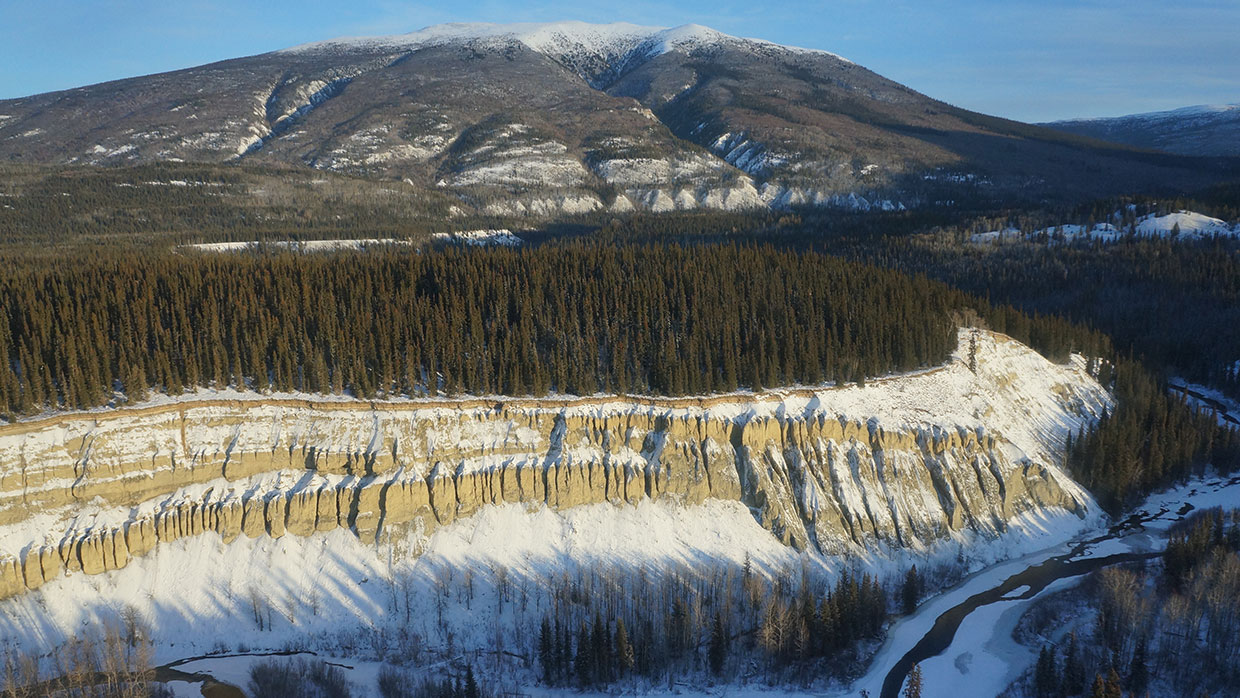
  • Cliffs among hills and valleys are usually a long escarpment of exposed clay and softer soil and rock and as such may be scalable (with difficulty) without special equipment or training if one can find a lower section or a defile. The average height of such cliffs is 50+(d3x50) feet.
  • A long cliff or escarpment is a significant barrier to movement, and ravines eroded by rivers, ancient roadways cut into the cliffs, or other places where the heights are easily traversable become significant military and commercial locations.

FERTILE VALLEY

  • These vales are rare in the region, but they do exist. Often warmed by geothermal activity and with soil enriched by silt, volcanic ash, or perhaps a stranger force altogether, these small oases are capable of supporting life and agriculture like no other area in the land. As such they are some of the most densely populated, and most hotly contested.

HAZARD ZONE

  • These are areas that are hostile to life, dangerous to enter, and often beyond contemporary understanding. Nuclear waste pollution, magic gone amok, alien terraforming, eldritch invasion, dimensional collision, mega-haunting, generational super-curse. Needless to say, no two are alike, and there is always sweet loot to those who can brave (and survive) them.

SPECIAL

These are single-hex special features that are significant enough to be widely known and even serve as landmarks. Smaller and less significant versions of all of these may exist in the region, but aren't important enough to affect the big picture.
  • Caves. There is a large cave complex in this area, with multiple entrances and likely uncharted depths. Such large complexes are inevitably used as lairs for bandits, monsters, fugitives, renegades, devil worshipers, necromancers, and worse. They also typically connect to the Underworld. Usually found in rocky or raised terrain such as hills, mountains, and cliffs.
  • Butte. Also known as a tor. A large, usually flat-topped outcropping of rock that projects out from a ridge or stands alone in lower terrain. Highly defensible and almost invariably occupied by a fortification or settlement. Or ruin.
  • Volcano. An active cone. May not be erupting or even smoking, but absolutely has lava pools in the caldera and fresh magma in its veins.
  • Waterfall. A significant waterfall. 100+d100 feet high. Place it on a cliff or mountain border, either on an existing river or add one.
  • Rapids. A particularly savage and long stretch of treacherous waters in a river. The rapids are dangerous enough to prevent normal river travel, requiring portages or overland travel. If the river is a significant enough travel or trade route there may be one or more settlements built next to the rapids.
  • Hotsprings. A large region of geothermal activity. Hotsprings, heated pools. geysers. Such locations often have healing properties and religious significance attached to them, but can also be a hazard crossing. Lava tubes and underground springs may connect this location to the Underworld.
  • Crater. A large crater, broad enough to build a town in or be filled by a (poison) lake. Extinct caldera, meteor impact, bomb blast, alien crash site.
  • Epic Peak. A singularly tall mountain peak.  10,000 + 100xd100 feet high. Upper slopes are likely impassable or unexplored. Almost always has mythic and religious significance.
  • Road. No current Prince has the time, resources, or reach to build or even maintain proper roads. However, some roads from previous ages have withstood the test of time and remain usable. Commerce, people, and warbands all make use of them and they can be strategic hotspots. Imperial roads are graded and paved with slabs of stone. Druidic roads are of packed earth and stone, where the lingering magics have kept them free of root and weather. Ancient roads are lingering traces of neolithic times, raised causeways of cyclopean stone bricks. Pre-apocalyptic roads are asphalt and pavement with occasional remains of overpasses and off-ramps.
  • Bridge. These bridge rivers, gap ravines, cross wetland. They remain vitally important to travel and commerce, as no Prince is capable of constructing new ones. Imperial bridges are arched brick and concrete marvels. Druidic bridges are petrified and shaped wood, living trees molded into spans and sturdy enough to defy time. Ancient bridges are simple, great cyclopean slabs sunk in the riverbed and spanned by further slabs. Locals now replace missing slabs with wooden planks in pale imitation. Pre-apocalyptic bridges are suspension bridges of rusted iron girders and crumbling asphalt.
  • Canyon. Deep, steep-sided. Might be a river valley, a tectonic rift, caused by a vast collapse of part of the Underworld, the scar of an orbital laser, or the product of some magical calamity.
  • Necropolis. A valley of the dead. A field of barrows. A tomb complex. Dozens or even hundreds of tombs, sepulchers, burial grounds, barrows, kurgans, and other large burial structures fill this area. It has been in use for a long, long time, may still be in use, and likely by more than one group. Looters are common, as are deadly traps and curses and guardians.

EXAMPLE


  1. Cliffs, 4 long
  2. Canyon, 6 long with a single 1-long branch
  3. Forest, 17 hexes
  4. River. The canyon seemed a logical choice.
  5. Cliffs, 8 long. The existing canyon and cliffs suggest a raised area, so these cliffs complete that.
  6. Mountains, 17. I put these in the centre, along the canyon. The river flows out of mountains, swollen with snow-melt.
  7. Special - Necropolis. Had two Ancient layers and one Imperial. Placed it on the western edge of the mountains. A valley of the dead.
  8. Forest, 81 hexes. Filled in the western edge of the area. Upcountry forests.
  9. Hills, 69 hexes. Connected the mountains down to the bottom of the region.
  10. Hills, 45 hexes. Put them along the top cliffs to complete the elevated area.
  11. Mountains. Didn't roll for hexes, just filled in the gap between the new mountains and the large western forest.
  12. Fertile Valley, 14 hexes. Put this in the lowland to the north-east, fed by the river coming down out of the mountains.
  13. Special - Caves. Put it at the base of the cliffs. Maybe it connects through the Underworld to the necropolis.
  14. Special - Butte. Put this on the western forest. Probably going to be the capital of whichever prince claims that area.
  15. Forest, 46 hexes. I reduced it to 29 and filled the top hexes but left a gap between this forest and the fertile valley.
  16. Special - Canyon. 12 long, with two branches 1 and 3 long. I put this through the western forest and hills to the northern cliffs, then put another river in it.
  17. Lake, 3 hexes. Put this at the base of the southern hills, then connected it by river to the canyon.
  18. Lake, 10 hexes. A big lake. Placed it on the east, next to the fertile valley.
  19. River. Added a river coming down out of the hills to feed the big lake, then connecting to the first river.
  20. Cliff, 5 hexes long. Put them between the big lake and the hills. That lake is probably going to be an important waterway for traffic getting around the cliffs.
  21. Wetland, 12 hexes. Put them south of the big lake and added another river coming from the south-east to feed the lake.
  22. Fertile Valley, 4 hexes. Upped to six and put them around the south-west lake in the hills. Secluded and remote, but valuable territory for princelings to fight over.
  23. Mountains, 27 hexes. Dropped it down to five and filled in the area east of the big lake.
  24. Special - Waterfall. The lake coming down out of the hills to feed the big lake seemed logical. There's obviously caves behind it.
  25. Special - Caves. Convenient. Put these next to the small lake in teh southern hills. Definitely connect to the caves behind the waterfall.
  26. Forest. Didn't roll for size, just filled in the last ten hexes south of the wetlands.
And that's the terrain and special features for this region. I could add another few special features, but I think the terrain is dense enough as it is  Next step is placing Major ruins.

Saturday, February 15, 2020

LightBlackHawke Part 2 - They Came from the Land of the Ice and Snow

The Barbarians

To hear the priests of the Sun Lord speak, the northern people who rule the north-eastern peninsula are violent, heathen baby-eaters who are the enemy of all civilization. The truth is somewhat different. The Ihmiset, as they call themselves, are hardy seafarers from the cold lands across the eastern sea. Their wolf-headed longships have visited the eastern coast for many years, as raiders and traders in equal measure, plundering the rich lands of the Great Kingdom, and trading amber, ivory, silks, and spices from across the sea for furs, timber, tin, and bronze.


In the time of grandmothers, the Ihmiset warlord Sirkku Honeyhanded gathered a host of wolfships that became known as the Great Heathen Army and invaded in earnest. They crushed the twin Combrigantes kingdoms on the north-east peninsula and then moved south against the Great Kingdom. The orca banners of the Ihmiset penetrated deep into the southlands before being turned back. Sirkku was slain, and her three children divided the conquered lands to the north between them.


The Ihmiset now rule almost uncontested in their new realms, intermarrying with and integrating the Combrigantes folk. More wolfships arrive every spring, brought by the prospect of good farmlands and glory.


The most powerful of the Ihmiset kingdoms is Uusivuono, called the Snow Barbarians by the southerners. The kingdom was founded by Sirkku’s eldest son Jarkko Blackfish and dominantes sea traffic in the Grendep Bay and the rich tin mines of the Corusk Mountains.


The Frost Barbarians, actually the kingdom of Viljmaa, is ruled by the descendents of Inka the Clever, daughter of Sirkku. They have made peace with the mountain folk of the Griff Mountains and farm the good lands north of the Timberway.


The cold lands of the Ice Barbarians are possibly less hospitable than the Ihmiset homelands across the sea. Here the children of Sirkku’s youngest son rule over the lands he claimed and called Karhea. The cult of oksi, bear-worship considered taboo by most Ihmiset, flourishes here and Karkean warriors war constantly with the peoples to the east and even their cousins to the south.


Generating a Barbarian Background

You are from

1 - Viljmaa, 2 - Uusivono, 3 - Karhea


Your family’s patron deity is:

1 - The Thunderer, 2 - The Blackfish, 3 - The Earth Mother, 4 - The Huntress, 5 - A demi-god ancestor, 6 - The Bear


Before becoming an adventurer, you were:

1 - A seawolf, plying the sea as a raider and trader.

2 - A shieldbearer in a lord’s retinue

3 - A farmer

4 - An artisan

5 - A hunter

6 - A priest of the Ihmiset gods


You became an adventurer because:

1 - Your lord converted to the worship of the Sun Lord and banished anyone who would not convert

2 - A family member was revealed as a worshipper of the Bear, and you had to flee or be caught in an over-zealous purge

3 - A priestess of the Thunderer prophesied that your destiny lay in the wider world.

4 - Your ship was wrecked on a distant shore.

5 - You hired out to a southern lord as a mercenary and were left far from home when she died.

6 - A loved one was lost on a voyage south and you have sworn never to return until you find them.

7 - You tried to sell fraudulent goods to a lord and had to flee when the scam was revealed.

8 - You converted to the Sun Lord and were pressured to leave by your family.


Monday, February 10, 2020

LightBlackHawke Part 1 - The Nomads

I'm kind of fascinated by the 1e World of Greyhawke supplement. I love the way it gives just enough information to spark ideas without burying you in a bunch of lore and other nonsense. While it absolutely carries a lot of the old ideas around "race" and human-centric worldbuilding that Gygax shoved into all his work, there's clearly something about it that has made it such a beloved setting for so long. And my preferred way of finding out why something works is to pull it apart and then try and put it back together again. So that's what this blog post series is gonna be. I'm going to take the OG Greyhawke map and rewrite the gazetteer to my liking and see if what I end up with is as intriguing as the original.

Plus it's an opportunity to workshop the way I want to communicate worldbuilding and character building through random tables and other gameable nonsense.


The Nomads

fuzzy wuzzy was a cow.
Nilfanion [CC BY-SA (https://creativecommons.org/licenses/by-sa/3.0)]
The northern nomads - who call themselves the Bolucht, or “people of the cow” - say that they are the direct offspring of the Sky Father and the First Cow. This indiscretion enraged the Earth Mother and she banished them to lands where no crops grow and storms rage across the cold plains winter and summer alike. But the First Cow was more merciful, and sent her other children to live with the nomads. And so the shaggy kyloes cow became an integral part of the nomads’ life. Indeed, life on the northern plains could not exist without them.

The Bolucht live in small groups called camps, consisting of around ten tents - each with a family of five or six. The shaggy, hardy kyloes are mounts, beasts of burden, and food. An average family maintains a mixed herd of fifteen or more, often with a small collection of goats or sheep. Dogs, though they look more like the wolves that terrify the shepherds of settled peoples, and the large, sword-fanged snow cats are kept for hunting and companionship.

The Bolucht measure wealth in the size of a herd, and the richest boast herds of hundreds of animals or more. Camps spend the seasons moving back and forth across the northern plains as available foraging demands.

Each Bolucht camp is a miniature society to itself. There is no single leader, rather decisions are made collectively based on the wisdom of whoever is most experienced with the problem at hand. An elder might advise on matters of marriages, a hunter on choosing new foraging grounds, and a priest or sorcerer on matters of the spiritual. Beyond the camp, there is the clan, a loose confederation of many camps that is organized by a council of elders and wise ones chosen from among the camps. These elders give guidance on matters relating to the whole clan and dealings with other clans or the world beyond the plains. In turn, the clans meet and confer on business that affects the whole nation. Only in times of dire consequence is authoritative power given to a small group, and then only for the time of need. This unstructured but self-organizing leadership is often confusing to outsiders, who think of crowns and thrones and borders. But the Bolucht know that the harsh land they live in can only be survived through cooperation and respect.

Conflict between the Bolucht is not uncommon, but neither is it wasteful. Cattle raids and inter-clan skirmishes happen over the rights to grazing lands or water sources, but are more ritualized than truly violent. Monsters and predatory outsiders provide more than enough peril, and opportunities for valour, to go around. When roused to true war, a Bolucht horde is a trampling mass of angry bulls, daring lancers, and masterful archery.

The Bolucht are divided into two nations by the Fler river, the Tiger Nomads to the west, and the Wolf Nomads to the east. The Bolucht claim that each was founded by one of the two daughters of the First Cow - Sga and Mor. Each daughter took half of the newly born children of the First Cow and the Sky Father for herself and led them into the plains.

The Tiger Nomads claim the snow cat as their emblem, the Wolf Nomads the large grey wolves that roam the plains and the Burneal Forest. The Tiger Nomads trade with the Caliphate to the south, and with the ships that pass along their coast.  The Wolf Nomads have a tense peace with the denizens of the Vesve Forest, and skirmish constantly with the minions of Iuz across the Dulsi River.

Each nation maintains a single permanent 'city' - in reality little more than glorified trading posts where outsiders come to do business. These cities, Yecha in the west and Eru-Tovar in the east, boast fortifications that rival the greatest cities in the southlands - not because the Bolucht value hiding behind walls, but because they realized that whenever outsiders invaded they seemed compelled to lay siege to anything resembling a wall they could find, allowing the Bolucht to gather their strength and fight on open ground. Indeed, one popular feature of the midsummer clan gatherings are competitions to see which clan can most increase the height and depth of a wall section.

Generating a Nomad Background

Decide whether you are of the Tiger or Wolf Nomads

Your birth clan was: 1 - Star, 2 - Sun, 3 - Cloud, 4 - Snow, 5 - Rain, 6 - Moon

Your family god/dess was: 1 - Spring, 2 - Storms, 3 - Craft, 4 - Hunt, 5 - Winter, 6 - Trade

While among the Nomads, you were:
1 - A capable hunter. 2 - A daring lancer. 3 - A talented tailor. 4 - A burden. 5 - A creche-keeper. 6 - A goatherd.

You became an adventurer because:
1 - A drought killed half your family’s herd. You left home to reduce their needs.
2 - An outsider
stole a family heirloom and sold it. You have sworn to retrieve it.
3 - You murdered outside of a legal duel and were banished.
4 - You rejected an arranged marriage, defying the will of the elders and your family.
5 - You were captured by cultists of Iuz in a battle that left your family dead. You escaped, but now what?
6 - You were responsible for the loss of a herd, and you fled in shame.


Tuesday, January 14, 2020

The Red Masque Plague

CW: illness, vomiting, cannibalism, delirium and disassociation, vision loss, boils, facial scarring

Several iterations of my home setting ago I started digging into why "typical" TTRPG settings have such an astonishingly low population density and coming up with reasons for why that might be - inspired by this post from Blog of Holding. A plague seemed a good fit for my setting ideas given what the Black Plague and Plague of Justinian did to the world. That also spurred thinking about magical healing and antibodies and what would actually happen if you used Cure Disease in the middle of an epidemic. Does the magic confer immunity? How do? Does it stimulate the growth of antibodies, or does it just wipe out the disease?  Thus was born the Red Masque plague.

The Red Masque Plague

The Red Masque plague swept across the world in the time of our grandmothers' grandmothers' grandmothers, killing three out of every five in some places. Now it returns every few years, weaker, localized, less potent, but still deadly. Still a terror. Even a suspicion of an outbreak can cause hysteria and violence as people try to quarantine themselves, escape the illness, and destroy the infection. That such panic can worsen the problem or spread the infection further is disregarded in the face of a nearly existential horror. Still worse than the disease or the reaction is what it awakens in some and the depravity it inspires in them.

Stage 1. No visible symptoms beyond a slightly elevated temperature and a mild cough. Lasts d4+4 days. At the end of this stage, the infected can make a CON save if they have higher than average CON. A success means they have fought off the infection and are Red Masque Resistant.

Stage 2. Symptoms are severe and look like a bad flu. Vomiting, fever, dizziness, loss of appetite. Infection is highly contagious and airborne. Magical and mundane healing have little impact on the symptoms - often the first clue that the illness is more than a simple flu. This stage lasts d4+3 days. Every morning the subject must make a CON save or receive only half the benefits of resting. If they succeed on five of these saves in a row, they recover and are Red Masque Resistant. Otherwise, they move to Stage 3.

Stage 3. At this point the plague is in full force. Painful red boils appear around the subject's eyes and mouth, eventually spreading to cover most of the face and inside the mouth and throat. Delirium is common. The infection is only transmitted through fluids at this stage. Exhaustion, dehydration, and organ failure can occur as the disease worsens. Survivors will be left with facial scarring and potentially loss of vision. This stage lasts 2d6+2 days. Every morning the subject must succeed on a CON save or lose 1 CON. This ability reduction will not heal naturally so long as the subject is afflicted. Any heavy exertion requires a CON save against exhaustion. If the subject's CON reaches 0, they die. If they survive the full course of Stage 3, they recover and gain lifelong immunity to the Red Masque. They must roll d20 + their current CON bonus on the Red Masque Recovery table.


Treating the Red Masque Plague

In Stage 1, magic that normally cures diseases has a 66% chance to work. Mundane curatives that are not the Red Masque Vaccine will not work at all. If a sufferer is cured magically, they gain no resistance to the disease and can be reinfected normally.

In Stage 2, only high-level magic can cure the disease, and then still with only a 66% chance of success. As before, being magically cured will not confer any resistance and reinfection is possible.

In Stage 3, there is nothing that can cure the infection except time. Magical or mundane treatments that improve CON or give bonuses to saves will still function normally.

The Red Masque Vaccine

There is a single mundane method of treating the plague, based on ancient formulas and ritual magics. Anyone with the knowledge can gather the materials and perform the ritual, treating ten people per day. Learning the formula and ritual requires months of study and practice, but the base materials are simple and can be gathered from almost any natural environment. Someone who receives the Vaccine while in Stage 1 is cured, and resistant to the disease for a full year, with a 33% chance to gain permanent Red Masque Resistance.

Red Masque Resistance

Anyone who has survived the full course of the disease develops a natural resistance to future reinfection. They have advantage on all saves against the disease, and may make an additional save to avoid being reinfected at all.  They are fully immune to the disease for thirteen full moons after gaining resistance.

Red Masque Delirium

There is another, even more horrifying effect of the disease. Everyone who reaches Stage 3 of the disease has a 5% chance to develop the Delirium, a disassociative state where they hunger for the flesh of people infected by the disease. These unfortunates, unlike other sufferers, appear stronger and more resilient, and completely detached from any sense of morality or connection to others.

Every night, there is a 50% chance someone with the Delirium will seek out and try to consume another infected. Every time they successfully eat infected human flesh their STR, CON, and DEX scores increase by 1, including beyond any normal limits.

If either score reaches 26, they lose their humanity completely, being overtaken by the Delirium forever. They stop saving against the Plague and recover all lost CON immediately, and will go on a rampage of cannibalistic gluttony and murder until destroyed, driven away, or forced to seek a new source of food.

There are always stories of those who seek the power the Delirium can grant and seek it out. Stories that never end well. There are also whispers that those with the Red Masque Resistance can induce it at will by eating the infected dead...

The Red Masque and Necromancy

The corpses of those who died of the plague remain infected and contagious for several weeks after death, necessitating cremation. Scavenging animals and corpse eating undead, such as ghouls and ghasts, can become new vectors for the plague and transfer it to new areas by bites, droppings, or being eaten themselves.

More sinisterly, necromantic magic proves more potent when used on the corpses of the infected dead. Any spells cast that raise or create undead from corpses still carrying the plague count as being cast at one level higher than normal, and the resultant undead gain an additional HD.

Wednesday, January 8, 2020

The Long Dark January of the Soul

It's been raining forever. Or at least it feels that way. Or maybe it really has been. When was the last time you saw the sun? Really think. Does it feel like a dream? A memory tied to some other place, some other person?

An endlessly grey has settled over the land. Rain without end. Not the hard, purifying rain of the tropics or the light, refreshing summer spray of the taiga. Day after day of slate grey skies and endless pissing coastal rain that soaks so slowly but inevitably through your cloak, your gambeson, your boots. It's insidious. And it never dries out. Your clothes are still wet in the morning but you have to pull them on and trudge onwards anyways.

Most people assume it's just a stretch of bad weather, or the whims of the gods. But the wise know something more sinister is going on.

While The Long Dark January of the Soul is in effect, roll on this weather table each morning.


For every day that goes by without seeing the sun, make whichever save, check, or test is most appropriate to mental health or emotional wellbeing in the game you are playing. (Did I make it clear this is rules for a TTRPG and not just a way of externalizing my own annual battle with seasonal affective disorder?)  You have a cumulative penalty for every additional day that has gone by. If you spend the majority of a day in a closed interior environment without fresh air and easy view of the sky, this save, check, or test is made with disadvantage.

If (when) you fail this save, check, or test, roll on the below table.

Finally, what is the cause of The Long Dark January of the Soul?


pants

Tuesday, October 8, 2019

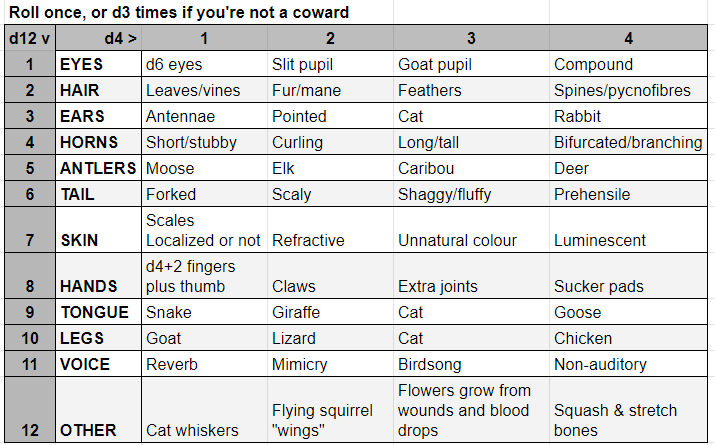
Weird parahuman traits table

I really like the idea of an adventure game setting where everyone is human... but "human" is something of a moving target (She-Ra is a good recent example of this imo).  I made a random table to generate the kind of weird variants that might show up in such a setting.  It could (and probably will), get Weirder in future drafts.