Devils and Faeries are extradimensional alien creatures who are will to trade you something here and now for the chance to take your soul once you're done piloting a meat suit. The power or gifts they trade to you invariably come with a hidden cost and/or run dry before you're done needing them, and the more you call on them the easier it gets to do so - for a while.
These rules are intended to complement the entry about calling on gods for augury and divine intervention. Those require effort and spending on your part, and are limited in effect. Making a deal with a Duke of Hell or a Fey Lord is comparatively easy and rewarding. You just, y'know, have to go to hell afterwards.
Rather than keep saying "Demon or Faery" or whatever, I'm just going to refer to them collectively as Powers. You could probably use this to include gaining power from eldritch Elder Things and whatnot but I imagine that to be more the theological equivalent of sticking your finger in a light socket.
Also, these rules assume a game where you don't instantly die at 0 HP.
MAKING A DEAL
Step 1: Identify a Power and find out how to contact.
Step 2: Conduct the ritual, offer the sacrifice. If things go well, the Power will appear and offer you a gift. If things go really poorly they'll still show up but you're not going to enjoy it.
Step 3: Trade a sliver of your soul for the gift.
Step 1 - The Power and the Ritual
There are three components needed to summon a power: the Symbol, the Incantation, and the Sacrifice. The Symbol must be drawn or etched on a surface - this is where the Power will appear. The Incantation is a ritual chant, song, howling, etc, that must be repeated while the sacrifice is made. Finally the Sacrifice must be made. Total up all the modifiers (given in the chart below) and roll a d20. If the roll is below the target, the ritual is successful and the Power appears. If a 20 is rolled, the Power still appears but they are bound by no ritual and will probably just drag your soul out of your body for fun.
Making a Deal Chart
Regular Sacrifice - Base target of 10
Rare Sacrifice - Base target of 15
Slivers Given - +1 each
Additional people conducting the chant - +1 each
Step 2 - The Bargain
Each Power has gifts they grant. The normal bargain is to trade Slivers of your soul for these gifts. You can always try to bargain for something else, but the Power will likely have more... exotic requests. Agree on the bargain, including specific terms for repayment. The gifts listed in the Power's entry are the most common things, but the list is not exhaustive.
Step 3 - The Price
If the price is one or more Slivers of your soul, payment is immediate. Mark them down on your sheet (or increase your running total). If the price was something, pay it now or arrange to pay it later under specific conditions.
PAYMENT COMES DUE
When you are reduced to zero hit points, or once per day while in the Power's home plane, roll a d20. If the result is under your current total Slivers given to that power a servant of their shows up to claim your soul. The servant's HD/CR/level is equal to the roll of the die. You ever die, then your soul is forefit and claimed immediately. You cannot be resurrected unless someone physically finds it and reclaims it (or makes another bargain to get it back). Some Powers only claim a soul for a given period, after which you can be resurrected.
If you have paid Slivers to more than one power, stack them when making the roll. So if you've paid 3 slivers to The White Prince, and 2 to the Fiachsidhe then upon being reduced to 0 HP if you roll a 1-3 a servant of The White Prince will appear, or a servant of the Fiachsidhe on a 4-5.
DESPERATE PLEAS
You can call out to a Power at any time for a gift. These gifts are usually much less potent than when making a sacrifice, but they can help in a pinch. The price is still the same, though.
When you make a desperate please, roll a d20. If you get over your total Slivers owed to that Power, the bargain is struck. You can increase the result rolled by up to +10 by offering a suitable sacrifice, in addition to the one or more Slivers spent as normal. Failure to follow through on the sacrifice generally has dire consequences.
THE WHITE PRINCE
King of Hell and All Demons, Wisest Teacher, the Sixth Pentarch
The White Prince is typically invoked through his greatest servant on the mortal plane, His Shadow. When he takes a soul, he binds it to the form of a familiar until they have tempted a wizard into the service of The White Prince.
Symbol: 19 white candles around a 19-pointed star drawn in red ink, red wax, or blood.
Incantation:
O Prince of Magic, hear us!
O Prince of Truths, hear us!
In the name of Your Merciful Shadow, I call to thee!
From the depth of this world of lies, I call to thee!
For the promise you made to all who live and die, I call to thee!
O Prince, who does not know of thy magic?
O Prince, who does not know of thy wisdom?
O Prince, open the door to the font of thy knowing
O Prince, let me bask in Your Divine Shadow
Holo dano dholo ka kaddk kluvd!
Holo dano dholo ka kaddk kluvd!
Holo dano dholo ka kaddk kluvd!
Sacrifice: Goat or sheep, a religious text, the blindfold of blind man
Rare sacrifice: A lamb, born with white wool and two heads
Typical Gift: A spell. Trades 1 Sliver per spell level. The new spell can be from any spell list, but must be of a level you would normally be able to cast.
A spell slot. You gain an additional spell slot. Costs 1 Sliver per level of the new slot. The slot can be one level higher than your current max, but this costs an additional 5 Slivers.
Rare Gift: Spellcasting ability. Choose a class. You can pick two 1st level spells that class has access to. You can cast these spells once per day, with the spellcasting ability of that class. You can only learn more by making further deals with The White Prince.
THE FIACHSIDHE
Mistress of the Wild Hunt, Immortal Hostess, Seneschal of the Green Court
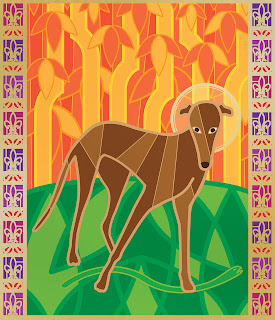
The Fiachsidhe is a powerful Faery noble, said to ride across the realm of Faery on a bronze chariot pulled by eight enormous hounds. She leads the Wild Hunt on excursions into the mortal realms, and enforces the laws of hospitality in Faery. She binds mortals to the form of a hound, and keeps them to pull her chariot for 100 hundred years. Of course, the Feary understanding of linear time is... loose.
Symbol: Nine dog skulls, stacked in a pyramid and inscribed with the nine names of the moon.
Incantation:
hairr suna feirr eddaldaiul du na
ai serr dha Fiachsidhe dha wairn hildas
ai serr dha Fiachsidhe dha hurdarr
ai serr dha Fiachsidhe dha ruilnas ull dsinfadr
ai serr dha Fiachsidhe du eain na
du daesh na
ai serr dha Fiachsidhe
Sacrifice: a fine feast, a bronze torc or trumpet, a stag heart freshly butchered
Rare Sacrifice: The heart of a man hunted and slain
Typical Gift: A point of Inspiration (or equivalent)
Roll one of your Hit Dice and increase your Max HP by the result. This cannot bring you above your maximum possible HP.
An Arrow of Slaying. The target type is of very narrow focus. If you know the True Name of the target, you get d3 instead of just 1.
Rare Gift: A Horn of the Hunt. You can sound this horn once per full moon to summon a 2d6 HD/CR/level servant of the Fiachsidhe. The servant will aid you for d4 hours and then return to Faery.
BATHIM, THE OPENER OF WAYS
Bathim is a duke of Hell, and knows the routes and ways between dimensions. He can speed travellers on their way, or mire armies for days. He appears as a muscular man with the tail and head of a snake, riding a roan horse. Souls he takes are bound to his horse's tail, to be dragged across the surface of one thousand roads.
Symbol:

Incantation:
Bathim, Bathim, open the way
Bathim, Bathim, show me the way
Bathim, Bathim, knower of doors
Bathim, Bathim, I call unto thee
Bathim, Bathim, show me the way!
Sacrifice: A soldier's foot, a horse, dust from another plane
Rare Sacrifice: The keystone of an interplanar doorway.
Typical Gift: Speeds your next journey to a known destination by d6 days (you will simply cover distance faster without seeming to)
Tells you the route to a named location
Opens a door, gate, or portal that no-one living has passed through
Rare Gift: Opens a stable gateway to another realm, OR, gives you access to a pocket dimension you could claim for your own.
BELHOR, THE MAKER OF CROWNS
Belhor is a powerful King of Hell, said to be second only to the White Prince himself. Belhor appears as stronger, more beautiful, more frightening version of the current monarch of whatever realm the summoner resides in, and is always crowned with fire. Belhor is said to have the power to raise the lowest commoner to the heights of power and nobility. Souls bound by Belhor are doomed to place ten thousand bricks upon the ever-growing walls of his infernal fortress.
Symbol:

Incantation:
Of all the Thrones and Princes, I exhort thee Belhor
Before all the Lords and Swords, I beseech thee Belhor
Belhor, maker of crowns
Belhor, breaker of kings
Belhor, who stands behind all thrones
Belhor, I call you!
Sacrifice: An eagle, the mane of a lion, the bones of a prince
Rare sacrifice: The head of a landed noble
Typical Gift: Tells you of a noble who will reward service with land and title, and the service they need.
Tells you of a noble who can be overthrown, and how it might be done.
Tells you of a title that lies vacant, and how it might be claimed.
Rare Gift: Belhor will tell you of a crown you can claim for your own, and how it might be won. The path will be hard, and there will be a condition you must meet lest Belhor reverse your destiny.